The links below each image will open them in full size for an easier reading experience. They can also be downloaded using the adjacent button.
Brief
My most recent contribution to Anbennar was a mission tree for the country of Zokka. This was my most significant contribution to the mod in terms of sheer scope, but also my most structured thanks to the familiarity I developed when creating my previous mission trees.
Anbennar is a community-led project, and the vast majority of contributions are self-led and driven. That being said, there is a very in-depth review process before implementation can even begin, and many things change before the final product can take shape. Oftentimes those changes happen over the course of a month or more, depending on developer and reviewer availability and pace. I proposed the initial themes for Zokka in mid-January of 2025. Review finished and implementation began just over a month later. A playable build was added to the public testing branch of the mod in mid-May of that year, and the final product was released on Steam at the start of July as a flagship component of The Final Empire update.
Themes
Different nations in Anbennar have different amounts of lore and details; there are hundreds of them, so this is to be expected. A mission tree for a given nation is generally meant to represent their “perfect canon” – a world in which everything goes as well as it could for that country, and they achieve all of their intended goals.
Despite being a very old country – colloquially known as “tags” in Europa Universalis IV terms – Zokka did not have much in the way of an intended goal, a history, or a story.
- “Zokka” is the name of the tag. It is a gnollish tag. Gnolls are a race of anthropomorphic hyenas, exactly like in Dungeons & Dragons.
- The tag is named after its ruler, just like every other gnollish pack in Anbennar. Specifically, this ruler is Zokka Devourer-of-Suns.
- Zokka is a fervent Xhazobkultist. This means he adheres to the Xhazobkult faith. This religion is, as the name suggests, a cult surrounding the Xhazob – a demonic entity that grants great power in exchange for sacrifices.
- The ultimate goal of a powerful Xhazobkultist is to form a pact with the Xhazob and become the Xhazobain. Xhazobains and Xhazobines (as written when referring to a female pactmaker) seal this pact by declaring a Great Xhaz; a holy war, with the intent of making mass sacrifices to the Xhazob.
- Zokka’s pack is cannibalistic. Cannibalism (and eating sentient beings in general) in Anbennar is generally accepted to magically confer some degree of power to the consumer.
- Zokka starts at war with the nation of Jaddari, led by the eponymous Commander Jaddar. Jaddar follows the Jadd, a new creed of the Sun Cult, a henotheistic religion which believes in the light of the god Surael vanquishing a great evil known as the Malevolent Dark. Zokka and Jaddar must face each other in single combat at the start of the game – in Anbennar‘s official canon, Jaddar wins this battle and Zokka is slain.
This information was a solid foundation, but offered little in the way of an intended final goal or motive for a campaign. Zokka should clearly feature as a central figure in the mission tree, as should the act of making pacts with the Xhazob and forming the Great Xhaz, but everything else was up in the air. As a result, the very first thing I did was decide on an ultimate goal for Zokka himself; and, well, he is the Devourer-of-Suns…

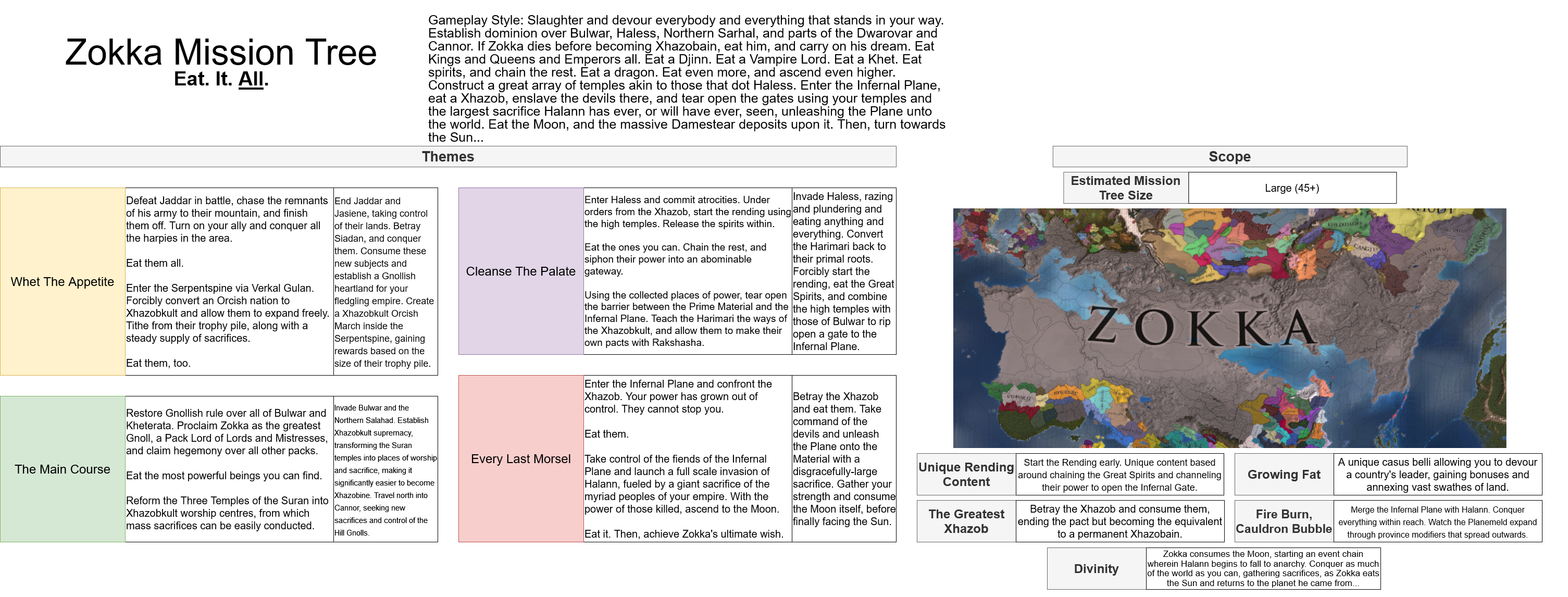
And after several rounds of review, this was the final result.

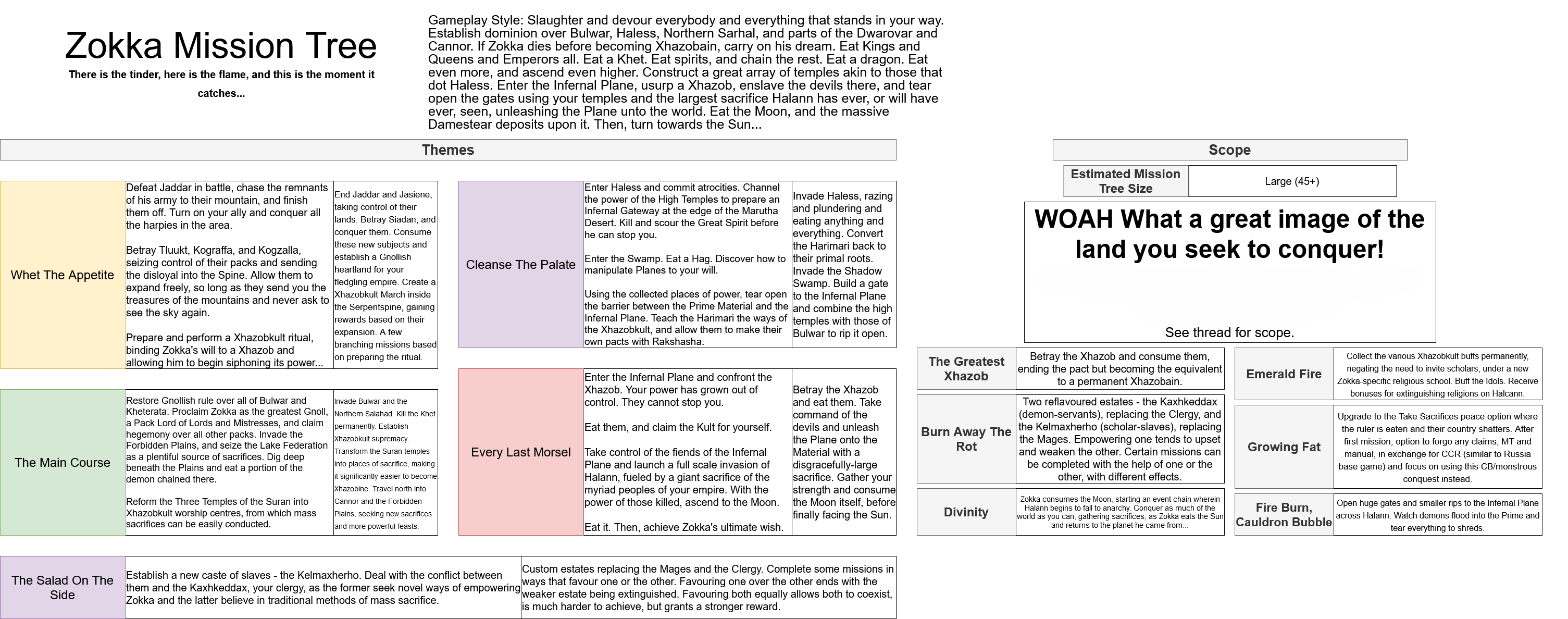
The theme boxes on the left detail the narrative and gameplay goals of a given section of the mission tree, whilst the boxes on the right describe unique systems or elements that underscore the entire thing. It should be noted that some of the proposed gameplay elements here were still changed after personal or public testing revealed that they just weren’t that fun – for example, in “Growing Fat” on the right, the option to forgo claims was instead changed to an option to convert your permanent claims into temporary ones, with a different modifier made to suit players that want a faster-paced campaign.
Content and Implementation
With themes approved, I moved on to creating the meat of the mission tree. This essentially consisted of organising a set of objectives for a player to complete – when completed, a reward is granted. I also had to list any events, event chains, and additional systems I intended the player to interact with. These events also have very tongue-in-cheek stubs connected to them, to help the reviewer understand what’s going on narratively with each one, and not just the gameplay effects.


There were many, many rounds of review to get the mission tree to the point seen above, but the general structure and intent behind each mission and event was preserved.
One aspect I was keen to maintain was the two missions in black at the very top of the mission tree. This is not standard design – usually, missions are completed top-to-bottom. These two missions (in reality, only one – the one on the right replaces its counterpart and reveals the second half of the tree when the latter is completed) serve a distinct ludonarrative purpose; they represent your ultimate goal of consuming the sun, and hang over the rest of the mission tree for the entire game. They are also mirrored by the final mission at the bottom, Lunacy, which fittingly has you eat the moon.
All Anbennar mission trees are designed using a flowchart such as this one, and by this point I was extremely familiar with the process and presenting my ideas in this way. In game, they look significantly less boxy and intimidating – Zokka’s tree was actually used to promote The Final Empire update in our first ever trailer!
I implemented the mission tree myself, using Paradox’s unique scripting language. I’m entirely self-taught, and previous implementations had made me learn the hard way just how complex seemingly innocuous things can be. That being said, Zokka’s implementation was surprisingly painless in the grand scheme of things, though it was certainly lengthy; I ended up writing over 5000 lines of code before finishing.
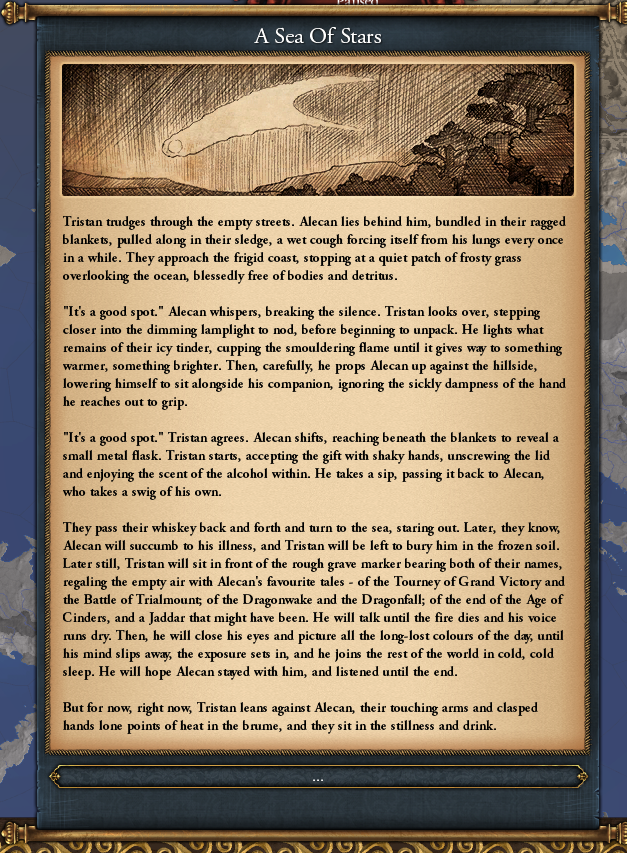
I also did all of the writing for Zokka myself, as I have done with all of my previous work. Anbennar has a thriving community and both writers and coders are on hand whenever help is needed, but I enjoy the creation process and wanted to do most of the work as an individual. Zokka’s localisation, including mission names and descriptions, events, modifier names and descriptions, government reforms, estate privileges, and more, came to more than 21000 words, the most I’d ever written for a single project. My favourite of those events, the penultimate event in the mission tree, is below.

What This Taught Me
Ask for help!
No, seriously. Although I was really happy with how the mission tree turned out, I was extremely burned by the end of the whole thing because I was so determined to do it all myself. My other projects had been smaller in scope, especially in terms of writing. There are definitely parts of the narrative and gameplay I feel could have been better if only I had asked one of the myriad available people to help me out with them.
Speaking of the gameplay, the second half of the mission tree devolved into chains of conquest and consolidation. This sort of problem is generally accepted as a necessity of Europa Universalis IV‘s gameplay loop, but I certainly see it as an area I could improve. My next (and as of writing this, current) project features elements that should make the mid-late game experience significantly more engaging for the player as a result, and I’m eager to see how it’s received in comparison. Still, Zokka was widely enjoyed by the Anbennar community, being rated as the 7th best mission tree in the mod in our end-of-year community survey.
Leave a Reply